Bottlenecking aircrews: the training cap behind Canada’s Global 6500 fleet
Stress-testing the RCAF Global 6500 acquisition: why mission expansion is colliding with training throughput. This Record isolates delivery sequencing, aircrew conversion limits, and per-taxpayer exposure embedded in Canada’s newest multi-role aircraft program.

THE FACTS
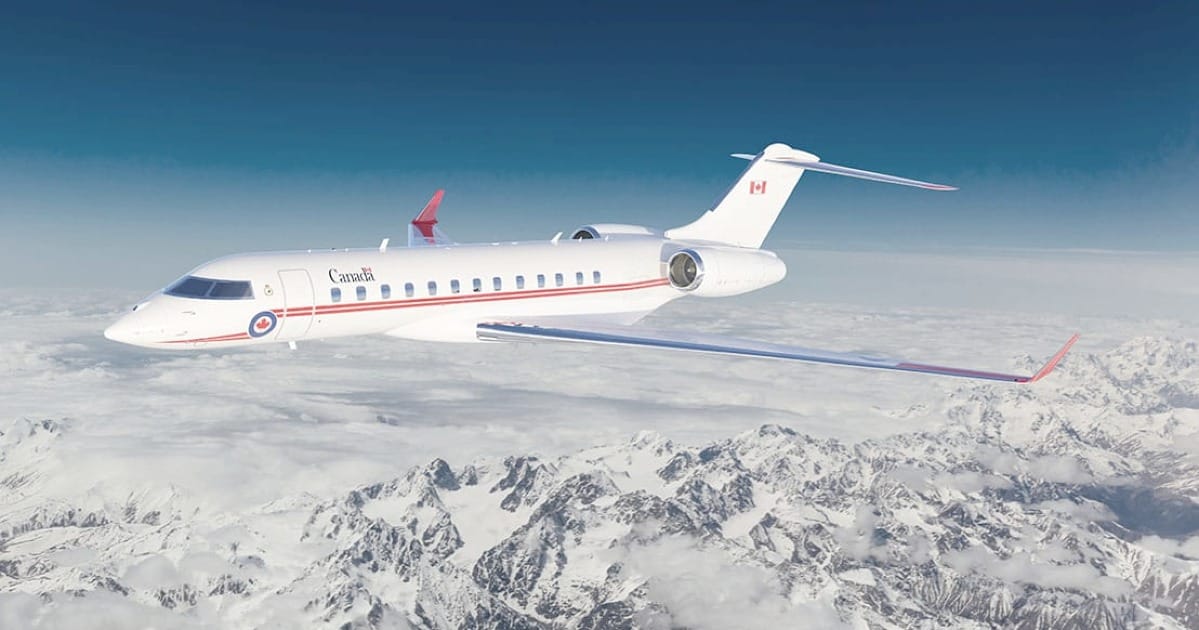
The Department of National Defence awarded a contract for six multi-role aircraft based on the Bombardier Global 6500 platform to replace aging CC-144 Challenger and CC-150 Polaris capability sets. The procurement was authorized under the National Defence Act as a capability replacement rather than fleet expansion. The aircraft are designated to support intelligence, surveillance and reconnaissance (ISR), transport, and communications relay functions.
The total acquisition value was disclosed at approximately $753 million USD, covering airframes, mission systems integration, and initial in-service support. Deliveries are scheduled between 2027 and 2029 according to departmental planning documents. The Royal Canadian Air Force will operate the aircraft from 8 Wing Trenton within existing force structure allocations.
Operational conversion requires aircrew qualification on a new platform governed by RCAF training authorities, with ISR mission systems requiring additional specialization beyond transport certification. Sustainment and upgrades are managed through Treasury Board–approved lifecycle funding. Oversight of cost and schedule risk is subject to review by the Office of the Auditor General.
TAXPAYER COST
| Income Category | Share of Tax | Cost Per Person |
|---|---|---|
| Top 10% | 54% | $130.27 |
| Middle 40% | 41% | $24.78 |
| Bottom 50% | 5% | $2.41 |
THE SPIN
Sources: CBC News, National Post
THE LEFT: Systemic Capability neglect
The Global 6500 purchase is framed as a belated attempt to patch structural neglect of Canada’s air surveillance capacity. Advocates argue that chronic underinvestment forced the RCAF to rely on aging platforms while global instability expanded ISR demands. The real failure, in this view, lies in political neglect that normalized stretched crews and deferred modernization. Training delays are treated as inherited damage, not a design flaw. Expanding capability is presented as overdue restitution rather than discretionary spending.
THE RIGHT: Procurement without accountability
Critics frame the acquisition as another case of Ottawa announcing hardware without controlling downstream costs. The focus is on taxpayer-funded expansion of missions without clear accountability for training backlogs and sustainment risk. Equity and capability arguments are dismissed as rhetorical cover for bureaucratic sprawl. In this frame, procurement precedes planning, leaving incentives misaligned. Delays are interpreted as predictable governance failure.
THE WORLD VIEW
The United States of America
Sources: Defense News, Politico
U.S. coverage frames the Global 6500 program as a modest ISR contribution within NORAD modernization. The emphasis rests on interoperability and burden-sharing rather than scale. Canada is interpreted as prioritizing niche surveillance roles while relying on U.S. capacity for depth. Training timelines are treated as secondary to alliance signaling. The program is read as symbolic commitment within continental defence planning.
The Global View
Sources: Financial Times, Jane’s Defence Weekly
International outlets frame the acquisition as evidence of middle-power force tailoring under fiscal constraint. Canada’s approach is interpreted as selective modernization rather than full-spectrum expansion. The emphasis falls on mission flexibility and industrial partnerships. Long-term implications are discussed in terms of sustainment capacity rather than deterrence impact.
WHAT THIS MEANS
Why is Canada buying "business jets" for the military?
Because a specialized military jet is often a "modified" civilian airframe.
While the Global 6500 looks like a luxury jet, the RCAF is using its long-range and high-altitude capabilities as a "truck" for sophisticated sensors and cameras. This Record shows that the primary goal isn't VIP comfort, but replacing the 1980s-era Challengers with a platform that can fly from Ottawa to Dubai without stopping - a critical requirement for global surveillance and rapid medevac.
Is this just another "VIP taxi" for the Prime Minister?
Partly, but the mission has expanded.
While these aircraft will move the Prime Minister and foreign dignitaries, they are officially designated as "Multi-Role." This means the same plane that carries a minister today can be configured for disaster relief, aeromedical evacuation of injured soldiers, or "eyes-in-the-sky" security missions tomorrow. The "Silent Story" is that the airframe’s versatility is intended to justify its high price tag by doing three jobs at once.
Will the $753 million price tag stay on budget?
That depends on the "Mission Systems."
The $753 million covers the planes and the basic military setup, but "Intelligence, Surveillance, and Reconnaissance" (ISR) technology is notoriously expensive to maintain and upgrade. This Record indicates that while the "buy" is authorized, the long-term "life-cycle" costs, keeping the cameras and sensors modern over 25 years are where the real fiscal risk lives.
Can we actually find enough pilots to fly these new planes?
This is a major bottleneck.
The RCAF is currently facing a personnel shortage. Qualifying a pilot to fly a Global 6500 is one thing; training them to operate complex ISR spy equipment at 40,000 feet is another. This Record suggests that even when the planes arrive in 2027, they may sit on the tarmac if the "training clock" for specialized mission crews hasn't finished.
Does this help the Canadian economy?
Yes, significantly.
Because the Global 6500 is built by Bombardier in Ontario and finished in Quebec, a large portion of the $753 million stays in the Canadian aerospace "ecosystem." This procurement is as much an industrial strategy to support 900+ high-tech jobs as it is a military purchase.
THE SILENT STORY
THE PILOT PRODUCTION CEILING
Public debate focuses on the $1.02B CAD price tag and the versatility of a "business jet" performing military missions. The binding limiter is the Aircrew Qualification Floor—the 18-to-24-month timeline required to convert an experienced pilot into a "mission-ready" commander on a new platform. The constrained system is the RCAF’s specialized training pipeline, which is currently managing a 2,000-person personnel shortage while simultaneously transitioning to multiple new aircraft fleets.
Think of the multi-role fleet like a high-tech tool that requires a master craftsman to use. You can buy the most advanced tool in the world (the Global 6500), but if your master craftsmen (senior pilots) are already working double shifts or retiring, the tool sits unused. In Canada, the federal government is buying the "tools" at a record pace, but the "school" for the craftsmen is struggling to keep up with the backlog from previous years.
This sequencing is a procedural lock-in. A pilot cannot move to the Global 6500 until they complete "Multi-Engine" training; they cannot lead an ISR mission until they achieve "Mission Commander" status; and they cannot train others until they have hundreds of hours on the specific airframe. These steps are "sequential," meaning you cannot buy your way past the time it takes for a human to learn.
This constraint is ignored because "Contract Awards" are a visible political event that creates an immediate sense of progress. "Training Throughput" is a slow, decade-long demographic grind that happens in flight simulators and classrooms. Political cycles reward the "Acquisition," while the "Physics" of human training is treated as a secondary administrative detail.
"The government has bought the fleet, but the cockpit is waiting on the classroom."
If the personnel shortage remains the governing force, the Global 6500 fleet will arrive in 2027 but may take until 2032 to reach "Full Operational Capability." The risk is that Canada appears to have a modern, high-tech air force on paper, while its real-world ability to fly missions is limited by a lack of qualified people. Over time, the gap between "Airframes Owned" and "Crews Qualified" becomes a major risk to national sovereignty.
SOURCE LEDGER
- Department of National Defence —Canada acquiring new multi-mission aircraft (2024)
- Department of National Defence —Strategic Tanker Transport Capability (2024 Edition)
- Department of National Defence —CE-145C Vigilance ISR Capability (2024 Edition)
- Department of National Defence —Departmental Plan 2024-25 (2024)
- Statistics Canada —High income tax filers in Canada, Table 11-10-0055-01 (2025 Edition)