When infrastructure funding meets approvals: how projects are stalling delivery
Auditing the $159B federal infrastructure pipeline: why funding flows faster than projects start. This Record isolates approval and capacity constraints and stress-tests long-term taxpayer exposure.

THE FACTS
The federal government tabled $159 billion in planned infrastructure program authorities over fiscal years 2025–26 to 2029–30, as set out in the planned statutory and voted infrastructure allocations. Most federal infrastructure funding is appropriated through transfer payment programs, which legally require signed contribution agreements before funds can flow, under the Treasury Board Policy on Transfer Payments. Federal departments lack authority to disburse infrastructure funds without approved terms and conditions, as prescribed by the expenditure control provisions of the Financial Administration Act.
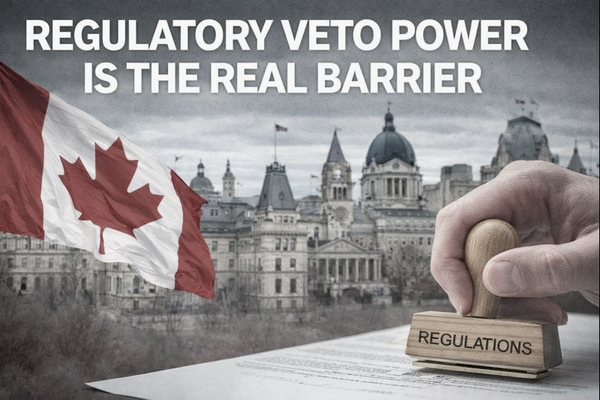
Infrastructure projects subject to federal review must complete sequential approval stages, including eligibility screening and environmental assessment, as mandated by the Impact Assessment Act. Provincial and municipal governments retain exclusive constitutional authority over land-use planning and permitting, which determines construction start dates under the division of powers in the Constitution Act, 1867. Federal infrastructure funds remain encumbered but unspent until project milestones are met, according to accounting treatment in the Public Accounts of Canada 2023.
The Auditor General of Canada has documented multi-year lapses and delayed drawdowns in federal infrastructure programs where projects were not construction-ready, as reported in the 2023 Reports of the Auditor General to Parliament. Lapsed infrastructure authorities are reprofiled into future fiscal years rather than cancelled, increasing out-year spending requirements, as disclosed in the reprofiling notes of the Main Estimates. Independent fiscal analysis estimates that federal infrastructure cash outlays extend well beyond initial budget windows, according to the Parliamentary Budget Officer’s Federal Infrastructure Spending: Update (2025).
TAXPAYER COST
| Income Category | Share of Tax | Cost Per Person |
|---|---|---|
|
Top 10%
|
54% | $2,750 |
|
Middle 40%
|
41% | $525 |
|
Bottom 50%
|
5% | $51 |
THE SPIN
Sources: CBC News, Toronto Star, National Observer, Financial Post
The Left: Systemic Underbuilding
The backlog is framed as a failure of federal leadership to bypass municipal obstruction and private-sector profit motives. Funding delays are treated as a sign of chronic underinvestment in social equity, where critical transit and housing projects are held hostage by "red tape" that only exists to protect entrenched interests.
When money sits in Ottawa instead of building communities, it is framed as a betrayal of the public good, allowing aging infrastructure to decay while the wealthy avoid the consequences. Skepticism of spending is framed as a deliberate attempt to starve the public sector of needed growth.
The Right: Unaccountable Spending
The envelope is framed as a massive accounting trick where "allocated" money is never intended to be spent. Huge headline numbers are treated as political camouflage for a bloated bureaucracy that cannot coordinate with the provinces.
Negotiations are framed as a "Ottawa-knows-best" approach that ignores local economic reality and burdens taxpayers with debt for projects that never break ground. The constant re-profiling of funds is framed as a lack of fiscal discipline, moving today's failures into tomorrow's budget to hide the true cost of government incompetence.
THE WORLD VIEW
The United States of America
Sources: The New York Times, Wall Street Journal
U.S. coverage frames Canada's infrastructure delays as a drag on North American competitiveness and supply-chain integration.
Democratic-aligned discourse appears to prioritize the slow pace of green-energy transitions and cross-border transit links as a missed opportunity for climate goals.
Republican-aligned discourse appears to prioritize the permitting bottleneck as a warning of how "big government" kills industrial growth.
Canada is interpreted as a partner with high regulatory friction that creates risk for U.S. investors looking for predictable construction timelines.
The Global View
Sources: Financial Times, The Economist
Global outlets frame Canada's infrastructure lapses as a symptom of "vetocracy": a system where too many layers of government can say "no." The lens emphasizes how high immigration levels meet stagnant infrastructure growth, creating a "per-capita recession" in service delivery.
Canada is interpreted as an advanced economy struggling to modernize its internal trade and transport networks due to constitutional fragmentation. Long-term fiscal risk is framed as "inflationary pressure" because today's delayed projects will cost significantly more when they are finally built in 2030.
WHAT THIS MEANS
If the money is there, why hasn't my local bridge been fixed?
Because a cheque from Ottawa doesn't buy a shovel.
Before a single dollar moves, your city and province must agree on the plan, pass an environmental audit, and sign a legal contract with the federal government. This Record shows that these "permitting gates" are often shut, leaving the money stuck in a federal bank account while the bridge continues to crumble.
Is this why my city says they have no money for transit?
Yes, partly.
Cities often have "theoretical" money promised from Ottawa, but they cannot spend it until they meet dozens of federal conditions. If the city cannot afford its own share of the bill or fails to get provincial approval, the federal funds stay "locked," creating a gap between what is announced and what is actually available to pay for buses or trains.
Does "re-profiling" mean the money is being stolen?
No.
It means the government is moving the "due date" for the money to a later year because the project isn't ready. However, because construction costs go up every year, the same $100 million will buy less infrastructure in 2029 than it would have in 2025. This reflects a hidden "inflation tax" on every delayed project.
Are these delays caused by politics or just bad planning?
It reflects a trade-off.
Federal laws require strict audits to prevent corruption and ensure environmental safety, which takes time. But the provinces have their own laws for land use. These two systems often crash into each other, meaning the "bad planning" is actually a result of two different governments trying to control the same piece of land at the same time.
Will this 5-year plan actually be finished by 2030?
Probably not.
Based on historical data from the Auditor General, a significant portion of the $159 billion will likely be pushed even further into the future. This Record suggests that unless the "permitting gates" are widened, the government will continue to announce spending that the system is physically unable to deliver.
THE SILENT STORY
APPROVAL CLOCKS GOVERN INFRASTRUCTURE
Public debate centres on funding totals and ambition. The governing force is approval throughput. Infrastructure delivery is governed by sequencing, not money.
Infrastructure delivery requires completed designs, environmental reviews, and signed contribution agreements. These steps cannot be parallelized across jurisdictions. Training skilled trades and securing permits impose fixed timelines. No amount of funding compresses statutory review clocks.
This constraint is ignored because budgets are visible while approvals are procedural. Political timelines reward announcements, not sequencing. Media coverage tracks dollars, not readiness.
"Pouring more water does not widen the pipe."
If this force persists, spending profiles will continue shifting forward. Apparent capacity will exceed real throughput. Fiscal commitments will appear strong while physical outcomes lag.
SOURCE LEDGER
- Parliamentary Budget Officer —Federal Infrastructure Spending – Update (2025)
- Treasury Board of Canada Secretariat —Policy on Transfer Payments (2024 Edition
- Auditor General of Canada —2023 Reports of the Auditor General of Canada (2023
- Department of Justice —The Constitution Act, 1867 (Full Text
- Statistics Canada —High income tax filers in Canada, Table 11-10-0055-01 (2025 Edition