Mixed signals: The Canada - China posture cost

THE FACTS
Canada adopted the Indo-Pacific Strategy as a formally approved whole-of-government horizontal initiative, establishing a single policy framework governing foreign policy, trade, defence, development, and security engagement across the region. The Strategy is administered through Global Affairs Canada as the coordinating department, with implementation authority distributed across participating departments rather than centralized in a single statutory program.
The Strategy allocates $2.3 billion in new funding over five fiscal years, appropriated through departmental reference levels rather than a standalone statute or fund. The funding is sequenced through annual Estimates processes, making continuation and reallocation subject to Treasury Board and parliamentary approval rather than automatic renewal.
The Strategy defines five strategic objectives that function as organizing pillars rather than binding performance targets, and it enumerates 24 discrete initiatives assigned across departments. Delivery responsibility spans 17 federal organizations, creating a horizontal governance structure in which progress is reported at the initiative level while outcomes are assessed collectively.
The Indo-Pacific Strategy’s horizontal initiative identifies an operational start date of April 1, 2023, aligned with the federal fiscal year. It also lists an end date of March 31 2033, extending beyond the initial funding window and requiring future fiscal decisions to sustain implementation.
Global Affairs Canada briefing material prepared for Parliament describes China as requiring a “realistic and clear-eyed assessment”, reflecting a formal shift away from engagement-first framing without codifying a single operational posture across trade, security, and diplomatic files. The Strategy does not formally designate China as a primary partner or adversary within its objectives, leaving implementation discretion to departments.
TAXPAYER COST
| Income Category | Share of Tax | Cost Per Person |
|---|---|---|
| Top 10% | 54% | $398.08 |
| Middle 40% | 41% | $75.56 |
| Bottom 50% | 5% | $7.37 |
THE SPIN
Sources: The Guardian, The Wall Street Journal, Reuters, National Post, The Hill Times
THE LEFT: Sovereignty means stop subcontracting to Washington
The Indo-Pacific Strategy is a cynical workaround for Canada’s domestic dependency on the U.S. security umbrella, masquerading as an independent Asia policy while following a Washington-dictated geopolitical script. By demonizing China - a critical economic partner - Ottawa is engaging in a dangerous game of moral theatre that prioritizes militarized posturing and imperialist tariff politics over the material security of Canadian farmers, workers, and marginalized communities.
The real scandal is the hypocrisy of demanding a "rules-based order" while mirroring the same exclusionary and aggressive tactics that destabilize the region and invite inevitable retaliation. This strategy fails to address the systemic roots of regional tension, choosing instead to entrench Canada within a colonial security framework that treats Pacific neighbors as assets rather than partners.
If Ottawa truly sought regional stability, it would stop performing for the White House and start building predictable, equitable diplomatic channels that protect public health and prevent the exploitation of the global South.
THE RIGHT: Bureaucratic entitlement and strategic decay
The Indo-Pacific Strategy is little more than a taxpayer-funded branding exercise, a sprawling list of initiatives designed to feed the federal bureaucracy while China continues its unchecked advance through hard power and economic coercion. By scattering $2.3 billion across 17 departments, Ottawa has ensured that accountability is non-existent; when everyone is responsible for "engagement," no one owns the catastrophic failure of deterrence.
This "horizontal initiative" is a masterclass in Ottawa overreach, confusing expensive announcements with actual national capability and treating geopolitical risk as a branding problem to be managed by public servants rather than a threat to be countered. Any talk of a "clear-eyed" reset is a naive risk transfer to Canadian industries and security agencies, leaving taxpayers to subsidize a strategy that refuses to define hard limits.
The moral failure lies in a governing class that prioritizes its own administrative expansion over the pragmatic protection of the Canadian economy and sovereignty.
THE WORLD VIEW
The United States of America
Sources: The Wall Street Journal, The Washington Post, Reuters
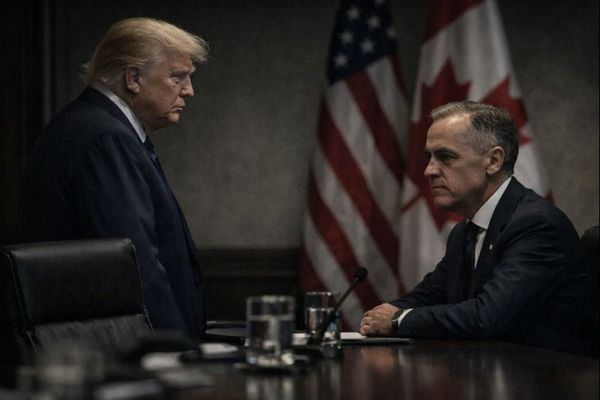
U.S. coverage frames Canada’s China posture as a stress test of alliance discipline under trade pressure. The strategic priority appears to be preventing tariff and market-access disputes from widening into a broader divergence on China technology, investment screening, and supply-chain controls.
Canada is interpreted as a mid-sized economy seeking leverage by diversifying trade, but still operating inside U.S.-set security boundaries. The constraint emphasized is asymmetry: Washington can impose binary choices, while Ottawa absorbs sector-specific retaliation. The leverage point is compliance risk, not shared growth.
The Global View
Sources: Financial Times, South China Morning Post, The Guardian
Global framing treats Canada as an indicator of how secondary powers rebalance when U.S. trade policy becomes less predictable. China is portrayed as offering selective economic relief and access in exchange for political distance from Washington’s containment posture.
Canada’s role is transactional: a supplier of food, energy, and capital-market legitimacy, not a decisive Indo-Pacific security actor. The constraint emphasized is credibility: mixed signals reduce bargaining power with both Beijing and U.S.-aligned partners. The long-run implication is fragmentation of trade rules into bilateral deals.
WHAT THIS MEANS
Will this change household costs or wages in the near term?
Not in the near term.
The $2.3B spend is spread across programs and departments over years. Any economic upside depends on private investment responses, not the funding line itself. The near-term effect is mainly diplomatic positioning, not consumer prices. The risk is indirect: if China policy wobbles, sector shocks land unevenly.
Is this another generational bill that younger Canadians inherit?
Yes.
The funding and institutional footprint outlasts a single government cycle. Program sequencing runs into multi-year hiring, contracting, and partnership timelines. If outcomes are unclear, renewal pressure rises because sunk costs accumulate. The intergenerational effect is less “debt” than permanent operating complexity.
Does this help Canadian exporters dealing with China risk?
Possibly, but not directly.
The Strategy is designed to diversify exposure across the Indo-Pacific, not guarantee China market stability. Export resilience depends on logistics, standards alignment, and market access that take time. If the China file shifts, businesses still need clarity on investment rules and retaliation risk. The constraint is predictability, not ambition.
Will the West and Ontario see this differently than the Prairies?
Yes.
Prairie exposure concentrates in agriculture trade vulnerability and retaliation cycles. Ontario exposure concentrates in manufacturing supply chains and security screening of investment. The Strategy spreads benefits across initiatives, but regional pain is sector-specific and immediate. Regional politics will track who bears the volatility first.
Does Canada lose national leverage if it sends mixed signals to China?
Yes.
Leverage depends on consistent threat models and consistent economic offers. If the posture appears reversible under pressure, both allies and China price in future concessions. That shifts bargaining into short-term deals rather than durable rules. The national-interest constraint is coherence across departments, not rhetoric.
THE SILENT STORY
CANADA DOES NOT HAVE A SINGLE CHINA POLICY CLOCK
Public debate frames Canada–China policy as a choice between “reset” and “resistance.” The governing force is not intent, alignment, or resolve. It is the absence of a shared execution clock across institutions responsible for China-related decisions. The Indo-Pacific Strategy functions as a coordination layer, not a command authority.
China policy is therefore not one decision. It is the cumulative outcome of submissions, approvals, reviews, and reporting cycles that sit in different departments with different mandates and risk thresholds. A trade action, a security screening, a diplomatic signal, and a development initiative do not clear the same gate or move on the same schedule. No single actor controls sequencing end to end.
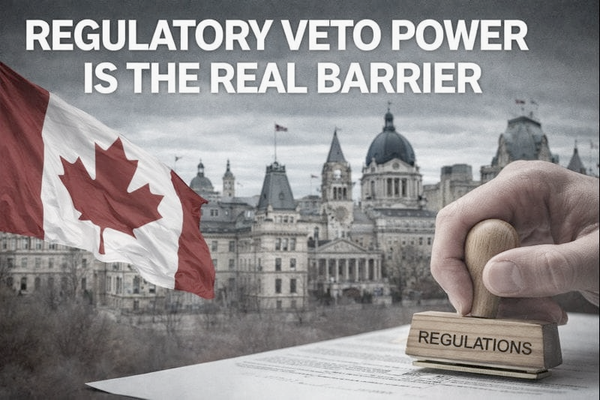
The Strategy hard-codes this fragmentation. Its five strategic objectives organize activity, but they do not collapse decision rights. Its five-year funding window authorizes spending, but it does not override statutory review processes, interdepartmental consultation requirements, or Cabinet sequencing. Money authorizes motion; it does not synchronize motion.
Throughput becomes the limiting factor. Legal review, procurement, Treasury Board submissions, intergovernmental coordination, and diplomatic staffing all draw from finite institutional capacity. These constraints cannot be parallelized without collision. A delay in one file propagates into others because progress is assessed horizontally, not independently.
The political signal can move immediately. The operational state cannot. Announcements are made in real time; execution resolves on institutional time. Media visibility attaches to posture shifts, while dependency resolution remains invisible. This produces a persistent gap between what Canada signals and what it can sustain.
"You can change the sign overnight but the building stays the same."
If this governing force persists, Canada’s China posture will continue to appear inconsistent regardless of individual initiative progress. External actors do not evaluate intentions; they evaluate repeatability. Over time, allies price Canada as constrained by internal coordination, and China prices Canada as conditionally flexible. The Strategy’s effectiveness becomes a function of sequencing capacity, not strategic clarity.
SOURCE LEDGER
• Global Affairs Canada — Canada’s Indo-Pacific Strategy (2022–2023 Edition)
• Global Affairs Canada — Canada launches Indo-Pacific Strategy to support long-term growth, prosperity and security for Canadians (2022)
• Global Affairs Canada — Supplementary Information Tables: 2025–2026 Departmental Plan (Global Affairs Canada)
• Global Affairs Canada — Deputy Minister of Foreign Affairs appearance before the Special Committee on the Canada–People’s Republic of China Relationship (2024-06-17)
• Statistics Canada — Table 98-10-0074-01 Economic family unit income statistics for income sources and taxes by family characteristics and decile group (2021 Census)