Interprovincial Trade Liberalization Colliding With Provincial Regulatory Control
The $530B Interprovincial Trade System: why regulatory sovereignty constrains market integration. This Record quantifies economic exposure and isolates the procedural limits shaping internal trade reform.

THE FACTS
Interprovincial trade in goods and services exceeds $530 billion annually, representing approximately 20 percent of Canada’s gross domestic product, according to national supply and use accounts annual interprovincial trade flows.
The Canadian Free Trade Agreement establishes a rules-based framework for reducing internal trade barriers while preserving broad provincial regulatory authority through listed exceptions regulatory exceptions framework.
Provincial governments retain jurisdiction over professional licensing, procurement, standards, and labour mobility under constitutional division of powers provincial jurisdiction.
Economic modelling by federal advisory bodies estimates that eliminating internal trade barriers could raise long-term GDP by up to $200 billion through productivity and scale effects GDP impact estimate.
Implementation of barrier reductions relies on bilateral or sector-specific negotiations rather than automatic harmonization implementation mechanism.
Dispute resolution under the agreement is complaint-driven and does not compel proactive regulatory alignment dispute process.
Federal commitments to internal trade reform do not override provincial statutes or regulatory colleges without legislative amendments at the provincial level legislative authority limits.
Timelines for barrier removal vary by sector and province, creating non-uniform market access conditions sectoral variability.
No statutory deadline exists for comprehensive elimination of listed exceptions under the agreement absence of deadline.
TAXPAYER COST
| Income Category | Share of Tax | Cost Per Person |
|---|---|---|
|
Top 10%
|
54% | $345.00 |
|
Middle 40%
|
41% | $165.00 |
|
Bottom 50%
|
5% | $32.00 |
THE SPIN
Sources: The Globe and Mail, Toronto Star, National Post, Financial Post
THE LEFT — ECONOMIC SELF-SABOTAGE
This is what chronic political failure looks like. Provinces cling to parochial control while Canadians pay the price through higher costs, fewer jobs, and stalled productivity. Internal trade barriers are not abstract policy disputes - they are systemic obstacles that protect insiders and punish workers, newcomers, and small firms trying to scale.
Ottawa talks about growth, but tolerates fragmentation. The result is a country that taxes like a unified economy while operating like thirteen disconnected ones. This is not about jurisdictional pride; it’s about refusing to dismantle inefficiency that everyone knows exists.
THE RIGHT — ACCOUNTABILITY WITHOUT AUTHORITY
This is classic Ottawa theatre: promise economic unity while lacking the authority to enforce it. Provinces control licensing, standards, and procurement, yet federal ministers posture as if they can bulldoze constitutional reality with press releases. Internal trade reform becomes an excuse for more committees, more negotiations, and more delay - all while costs compound quietly.
Taxpayers are told growth is being unlocked, but nothing actually changes. The problem isn’t barriers; it’s a political class that sells ambition without accountability and calls it progress.
THE WORLD VIEW
UNITED STATES
Sources: Wall Street Journal, Bloomberg
U.S. coverage frames Canada’s internal trade barriers as a structural inefficiency that limits North American supply-chain resilience. American outlets interpret provincial fragmentation as reducing Canada’s reliability as a single-market partner, particularly for energy, manufacturing, and services integration. The emphasis is on operational risk rather than constitutional nuance.
GLOBAL VIEW
Sources: Financial Times, The Economist
International economic media frame Canada’s internal trade issue as a productivity constraint unusual among advanced federations. Coverage focuses on the contrast between Canada’s open external trade posture and its fragmented domestic market. The long-term implication highlighted is diminished competitiveness rather than immediate political conflict.
WHAT THIS MEANS
Will this affect household costs and incomes?
Yes.
Higher internal trade costs reduce competition, keeping prices higher and wages lower over time. The impact is gradual but persistent. Benefits of reform accrue slowly, while costs of fragmentation compound annually.
Does this shift costs between generations?
Yes.
Younger workers face slower productivity growth and fewer national-scale opportunities. Older cohorts are insulated by existing structures. The burden compounds over decades.
Will service delivery improve?
Not quickly.
Licensing and standards reform requires sequential provincial action. Services scale only after regulatory alignment, not before.
Are some regions more affected than others?
Yes.
Smaller provinces face higher relative costs from restricted market access. Larger provinces absorb inefficiencies more easily due to scale.
Does this affect Canada’s global standing?
Yes.
Internal fragmentation weakens Canada’s credibility as a unified economic actor. Trade partners discount theoretical market size in favour of operational reality.
THE SILENT STORY
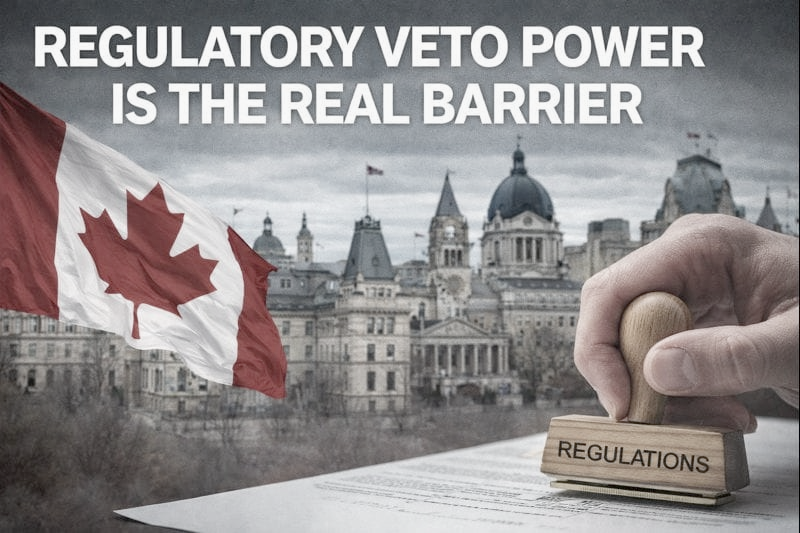
REGULATORY VETO POWER IS THE REAL BARRIER
Public debate treats internal trade barriers as a policy puzzle: find the right incentive, remove the friction, problem solved. But when the systems are actually traced, a different picture emerges. This isn't about economics. It's about who holds the legal authority to change the rules, and where that authority actually sits.
Start by mapping it out.
Every province controls its own licensing systems. Each one has its own professional colleges, its own standards bodies, its own procurement rules. When the federal government announces a new internal trade commitment, nothing moves automatically. There's no lever in Ottawa that updates a nursing license in Alberta or changes engineering standards in Quebec.
To recognize someone's credentials across provinces requires legislative amendments. Regulatory consultations. Each professional college, operating at arm's length from government, must revise its own rules. These steps can't happen in parallel. They're sequential. They're jurisdiction-specific. And federal money doesn't speed them up, because the bottleneck isn't funding. It's legal process.
The same constraint appears everywhere: legal time. Training pipelines, credential transfers, standards alignment all move slowly because authority is fragmented by design. Even when a premier wants reform, the change must pass through cabinet, then the legislature, then independent regulators whose mandates are insulated from political pressure. Steps cannot be skipped. The sequence cannot be forced.
And coordination happens one province at a time. One sector at a time. Often one profession at a time. There is no national switch.
So why isn't this visible? Because the incentives are misaligned. Budget cycles reward announcements: frameworks, targets, commitments. Those are visible. They make news. But the actual work? The statutory amendments buried in provincial law journals, the regulatory consultations that take months, the college-level rule changes that happen in obscurity. That doesn't get covered. It's slow, technical, opaque.
Progress gets measured in communiqués and press releases. Not in repealed clauses or updated regulations.
What looks like delay isn't resistance. It's not bureaucratic foot-dragging. It's constitutional sequencing. The system is working exactly as it was designed: authority first, money second, outcomes last.
Until that reality is acknowledged, that the governing constraint is legal time rather than political will or budget allocation, every reform promise will continue to overstate speed and understate friction.
"Funding can purchase commitment. It cannot purchase time."
SOURCE LEDGER
• Statistics Canada — Supply and Use Tables, Interprovincial Trade Flows
• Canadian Free Trade Secretariat — Canadian Free Trade Agreement
• Department of Finance Canada — Internal Trade and Economic Integration
• Public Policy Forum — Canada’s Internal Trade Challenge