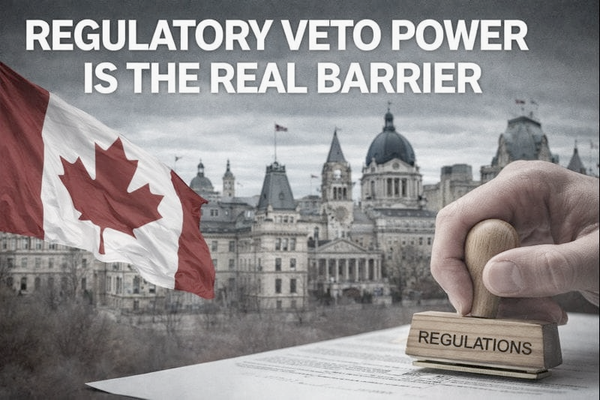
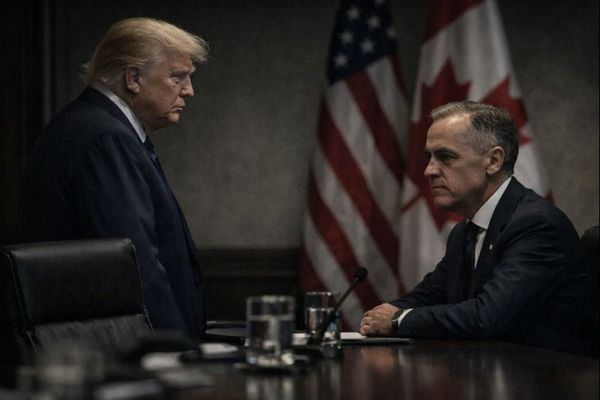
Inflating cross-border costs: uncertainty around North American supply chains
USMCA joint review: why a fixed renewal clock collides with election incentives. This Record quantifies Canada’s U.S. trade exposure and isolates the procedural constraint governing renewal risk.

THE FACTS
Canada’s merchandise exports to the United States totalled $596.2 billion in 2024 on a customs basis merchandise exports to the U.S. ($596.2B, 2024) .
Canada’s customs-basis imports from the United States totalled $471.3 billion in 2024, allocated by country of export customs-basis imports from the U.S. ($471.3B, 2024).
Canada recorded net exports of +$124.9 billion with the United States in 2024 under the same customs-basis framing net exports with the U.S. (+$124.9B, 2024).
The United States was the destination for 75.9% of Canada’s total merchandise exports in 2024 U.S. share of Canada’s total exports (75.9%, 2024) .
The United States was the source of 62.2% of Canada’s total merchandise imports in 2024 U.S. share of Canada’s total imports (62.2%, 2024) .
The USMCA specifies that the Parties meet for the first joint review on July 1, 2026 under its review-and-extension mechanism first joint review date (July 1, 2026) .
Under Article 34.7, the agreement can be extended if each Party confirms extension in writing extension by written confirmation (Article 34.7) .
If each Party confirms extension at a joint review, the agreement is extended for another 16 years 16-year extension term (Article 34.7) .
USTR issued a Federal Register notice on September 17, 2025 as part of the U.S. joint review process described for the July 2026 review Federal Register notice timing (Sept 17, 2025) .
USTR held a public hearing from December 3 to December 5, 2025 to receive views in preparation for the July 1, 2026 joint review public hearing dates (Dec 3–5, 2025) .
ECONOMIC EXPOSURE
| Exposure Channel | Indicator | What It Means |
|---|---|---|
|
Bilateral goods exports (Canada → U.S.)
$596.1B
|
Customs basis · 2024
|
Annual export volume exposed to market-access repricing under treaty uncertainty.
|
|
Export concentration (U.S. share)
75.9%
|
Share of Canada’s total exports · 2024
|
Higher concentration increases sensitivity to timing, renewal, and policy shocks.
|
|
Top trade-exposed sector
Energy products
|
28.8% of Canada → U.S. exports · 2024
|
Integrated energy supply chains reprice early when continuity is questioned.
|
|
Procedural deadline
July 1, 2026
|
First joint review (USMCA Article 34.7)
|
A fixed clock that can drive uncertainty independent of day-to-day trade flows.
|
THE SPIN
Sources: Reuters, Global News, National Observer
THE LEFT: Democracy held hostage by corporate trade rules
CUSMA is portrayed as a corporate-written constraint masquerading as a neutral trade agreement, designed to lock in investor power while hollowing out democratic choice. Renewal “uncertainty” is framed not as an accident but as a pressure tactic, weaponized to suppress labor standards, climate policy, and industrial planning the moment they threaten profit margins. Integrated supply chains are described as deliberately fragile, ensuring that workers absorb the shock whenever markets are rattled.
The moral diagnosis is systemic capture: trade governance is structured to discipline governments, not manage commerce, and households pay the price whenever democratic priorities collide with corporate leverage.
THE RIGHT: The cost of complacency
CUSMA is the inevitable bill coming due for decades of Ottawa’s reckless dependency on guaranteed U.S. access. This renewal risk is a predictable consequence of a governing class that traded Canadian leverage for political concessions and treated integrated supply chains as permanent entitlements rather than strategic vulnerabilities.
Taxpayers are now left exposed to the fallout of an irresponsibly over-concentrated economy that demands endless subsidies and emergency bailouts to survive basic market uncertainty. The moral failure is one of accountability: Ottawa chose a path of managed decline and dependency, and now expects hard-working Canadians to absorb the staggering cost of its own administrative complacency.
THE WORLD VIEW
The United States of America
Sources: Reuters, The Wall Street Journal, Politico
U.S. coverage frames the joint review as leverage management rather than treaty maintenance, with attention on which domestic constituencies can force concessions. The agreement is interpreted as a tool to re-balance manufacturing incentives and constrain “free riding” by partners through enforcement and tariff threat credibility.
Democratic-aligned framings tend to prioritize supply-chain stability and China competition, while Republican-aligned framings emphasize border control, industrial reshoring, and unilateral bargaining power. Canada is positioned as high-dependence and therefore high-influenceable, with the review clock treated as a deadline to extract visible wins.
The Global View
Sources: Financial Times, The Economist, Nikkei Asia
International coverage frames the review as a stress test of rule-based trade under electoral-cycle bargaining, with North America treated as a single production platform facing fragmentation risk. The issue is interpreted as a signal about the durability of U.S.-led trade architecture and the reliability of treaty extensions under domestic political incentives.
Canada is framed as a mid-sized economy concentrated in one market, with diversification narratives rising as a hedge rather than a replacement. The long-run lens emphasizes that uncertainty itself can reroute investment, even if legal terms remain unchanged.
WHAT THIS MEANS
Will this make everyday prices jump in Canada soon?
Not directly.
CUSMA renewal risk mainly moves through investment decisions and supply-chain planning before it shows up at checkout. If tariff threats become credible, firms can reprice contracts, hold inventory, or delay shipments. The first household effects tend to be sporadic price spikes in trade-exposed categories rather than a uniform inflation wave.
Are younger Canadians stuck with a weaker job market from this?
Yes.
Trade uncertainty concentrates damage in entry-level hiring pipelines in manufacturing, logistics, and trade services. When capital spending pauses, apprenticeships and junior roles are often the first throttled. The generational effect is slower wage progression in regions tied to export platforms.
Does this put Ontario’s auto ecosystem at risk first?
Yes.
North American auto production relies on cross-border sequencing where parts and subassemblies cross borders multiple times. A renewal threat functions like a tax on planning, raising the value of relocating future model allocation decisions. The risk shows up as “next investment” being redirected before any plant closes.
Will Western Canada feel this the same way as Ontario and Quebec?
No.
Western exposure clusters in commodities and energy-linked supply chains, where pricing is global but market access is still concentrated. Ontario and Quebec exposure clusters in manufactured goods and integrated production platforms. The regional difference is how quickly firms can reroute sales when uncertainty rises.
Does this weaken Canada’s national leverage abroad?
Yes.
High dependence on one market reduces bargaining flexibility in other relationships. When Canada must prioritize stabilizing a single corridor, it constrains bandwidth for diversification, defence-industrial alignment, and strategic trade positioning. Reputation risk arises when partners interpret Canada as structurally constrained, not policy-flexible.
THE SILENT STORY
RENEWAL IS GOVERNED BY DATE, NOT A DEAL
Public debate treats CUSMA as a permanent piece of infrastructure and the joint review as a routine diplomatic meeting. What actually governs outcomes is the renewal clock embedded in the agreement — and the incentives it creates long before any tariff is imposed. The system being governed is not trade volume or cooperation, but the legal continuity signal that determines whether investment plans can survive another cycle.
The joint review is a procedural gate, not a conversation. It is the moment when extension must be affirmed in writing by heads of government, or uncertainty becomes the default state. Because renewal is an event rather than a standing condition, trade policy is pulled directly into electoral calendars, regardless of day-to-day commerce continuing uninterrupted.
This clock cannot be shortened by money. The binding steps are sequential: domestic consultations, formal negotiating positions, and political authorization must occur before confirmation can exist. Public comment and hearing requirements add fixed notice periods that lock the process to administrative time, not market urgency.
At the top, the logic is binary. Either all Parties confirm extension and the term rolls forward, or the agreement enters a countdown phase. Partial reassurance, rhetorical goodwill, and incremental adjustments do not substitute for the single signal markets watch: written renewal that removes term-risk entirely.
The blind spot persists because coverage follows conflict — tariffs, statements, posture — while the governing variable is sequencing. Political incentives reward visible toughness and symbolic wins, not early procedural closure. Media attention follows noise, not clocks.
“Deadlines govern outcomes”
As long as the renewal clock dominates, investment decisions will be priced for discontinuity even while trade continues normally. Capacity does not disappear; it is routed elsewhere first. The result is a system that looks stable on paper while quietly losing the next generation of production decisions.
SOURCE LEDGER
• Statistics Canada — Canadian international merchandise trade, January 2025 (The Daily) (2025)
• Congressional Research Service — USMCA Joint Review: Process and Role of Congress (2026)
• International Trade Administration (U.S. Department of Commerce) — USMCA fulltext (2023-09 PDF)
• Office of the United States Trade Representative — Public Hearing on the First Joint Review of the USMCA (2025)
• Statistics Canada — Canadian international merchandise trade, October 2025 (The Daily) (2026)