Caracas pressure diverging from relief access
Stress-testing the $58.55M Venezuela crisis funding: why access is governed by permits and partners. This Record quantifies per-filer exposure and isolates the throughput constraint that money cannot accelerate.


THE FACTS
On January 3, 2026 , Global Affairs Canada published a ministerial statement on Venezuela.
The statement records that Canada closed its embassy in Venezuela in 2019 .
The statement records that Canada is providing consular help through its embassy in Bogotá, Colombia .
Global Affairs Canada states Canada announced $58.55 million at the 2023 International Conference in Solidarity with Venezuelan Refugees and Migrants.
That same release states Canada has provided over $180 million since 2019 in international assistance related to the Venezuela crisis.
The release states there are almost 20 million people in need of life-saving assistance connected to the crisis.
Canada Gazette records the Special Economic Measures Permit Authorization Order (SOR/2025-50) entered into force on February 26, 2025.
The Order authorizes the Minister of Foreign Affairs to issue individual and general permits for activities otherwise restricted under SEMA-based regulations.
Statistics Canada publishes distributional tax-share data in Table 11-10-0055-01 used to allocate fiscal exposure across filer groups.
TAXPAYER COST
| Income Category | Share of Tax | Cost Per Person |
|---|---|---|
| Top 10% | 54% | $10.13 |
| Middle 40% | 41% | $1.92 |
| Bottom 50% | 5% | $0.19 |
THE SPIN
Sources: CBC News, The Globe and Mail, National Post, Toronto Star
The Left: International law betrayed by great-power impunity
This is a systemic failure of accountability disguised as “restraint.” When a crisis produces almost 20 million people in need, the moral test is whether institutions defend sovereignty and human rights consistently, not selectively. Sanctions and permits become procedural cover while violence and displacement are treated as externalities. The obsession with “order” and “stability” normalizes coercion, then offloads the consequences onto aid agencies and host communities. Equity and protection are deferred, again, to the margins.
The Right: Ottawa signals toughness, then hides behind process
This is taxpayer-funded symbolism wrapped in bureaucracy. Ottawa announces $58.55 million, then routes delivery through layers of partners, permits, and multilateral process that diffuse responsibility. Sanctions posture as control, but the permit regime admits the state can’t run its own restrictions without carve-outs. Meanwhile Canada has no embassy in Caracas, so verification and leverage are second-hand by design. The incentive structure is obvious: high-visibility announcements now, low accountability later, and the bill becomes permanent background noise.
THE WORLD VIEW
The United States of America
Sources: The Wall Street Journal, Associated Press, Reuters
U.S. coverage frames the issue as coercive leverage with operational tempo: strike capability, custody, and bargaining power over oil flows and regional security. Republican-aligned framing appears to prioritize unilateral authority and deterrence, treating multilateral constraints as optional friction. Democratic-aligned framing appears to emphasize legality, escalation control, and alliance management, but still treats energy and migration spillovers as core U.S. interests. Canada is interpreted as a legitimizing ally when it echoes rule-of-law language, and as a low-cost partner when it absorbs downstream humanitarian and migration pressures.
The Global View
Sources: Financial Times, The Guardian, Al Jazeera
Global outlets frame the issue as a stress test of sovereignty norms and the durability of multilateral restraint under crisis pressure. The dominant lens is institutional: whether international law and UN-centered legitimacy can constrain major-power action once force is deployed. Canada is interpreted as a secondary actor whose credibility is measured by consistency between sanctions posture, diplomatic presence, and humanitarian throughput. The long-term implication emphasized is precedent risk: once the line moves, enforcement becomes politics, and humanitarian systems inherit the operational debris.
WHAT THIS MEANS
Will this raise household costs in Canada?
Not directly.
The immediate exposure in this Record is fiscal, not retail. The $58.55M allocation translates into small per-filer amounts, but it is additive across multiple foreign files. The trade-off appears as budget crowding over time, not a line item at checkout. The constraint is that overseas delivery cannot be accelerated by writing larger cheques.
Are younger Canadians underwriting a file they can’t influence?
Yes.
The funding is financed within a general revenue base that younger cohorts enter as they start filing and paying more tax. The policy lever is federal, but outcomes are governed by access and partner pipelines outside Canada. That widens the gap between contribution and control. The generational exposure grows when “one-off” allocations recur across years.
Does this change how humanitarian aid actually gets delivered?
Yes.
The permit framework exists because sanctions create operational choke points for legitimate transactions. That makes delivery dependent on exemptions, paperwork, and intermediaries that can clear compliance. The throughput limit is administrative sequencing: vetting, contracting, reporting, and audit. Money changes scale, but it does not remove the steps.
Will Western Canada feel this differently than Ontario and Quebec?
Yes.
Regions tied to energy exports are more sensitive to Venezuela-driven oil volatility and headline risk. Ontario and Quebec feel the file more through federal fiscal aggregation and diplomatic posture than commodity linkage. Maritimes exposure is mostly indirect through national budget allocation and any migration-related service pressure. The regional split is not ideological; it is transmission channels.
Does Canada’s national interest gain leverage here?
This reflects a trade-off.
Sanctions signal alignment with democratic norms, but the lack of in-country diplomatic presence limits independent verification and influence. Consular dependence on Bogotá narrows real-time responsiveness for Canadians on the ground. The system ends up prioritizing reputational positioning over operational reach. In alliance terms, Canada’s role becomes supportive language plus downstream stabilization.
THE SILENT STORY
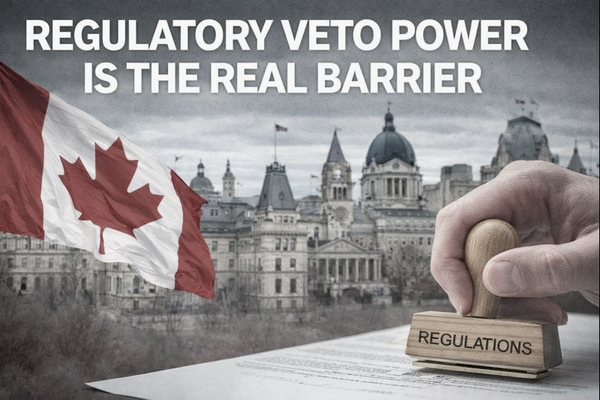
AID MONEY MOVES AT THE SPEED OF PERMITS
Public debate fixates on whether Canada is “tough” on Caracas or “doing enough” for relief. The governing force is administrative access. The system being governed is Canada’s sanctions-constrained aid delivery pipeline into a country where Canada lacks a resident embassy.
Delivery is not a straight wire from Ottawa to a beneficiary. Funds are sequenced into contribution agreements with implementing partners, then released against reporting, audit clauses, and eligibility checks that cannot be parallelized without raising fraud and compliance risk.
Sanctions add a second clock: banks and partners screen payees, logistics vendors, and end-use, and any blocked transaction forces a permit pathway or a redesign of the delivery plan. That sequencing is procedural lock-in, not politics.
Even when money is approved, access inside the country is governed by security conditions, local permissions, and partner presence, which constrain what can be verified and when. Canada’s consular posture being routed through Bogotá compresses situational awareness and reduces on-the-ground state capacity to corroborate delivery claims.
Training and specialization appear as partner capacity: experienced compliance staff, field security, and monitoring teams take time to recruit and rotate, and those personnel limits become throughput limits long before budget lines are exhausted.
This governing force is ignored because announcements are visible and instantaneous, while permits, audits, and disbursement schedules are slow and mostly invisible. Budget cycles reward commitments; operational systems reward documentation. Media coverage tracks intent and conflict, not the administrative physics of moving funds through sanctions.
"The government has promised a feast, but there is only one key to the pantry."
If the permit-and-partner clock persists, Canada’s Venezuela posture will continue to look larger on paper than it functions in practice. The risk is capability drift: funding and sanctions expand while delivery velocity stays bounded by compliance and access. Over time, the gap becomes reputational liability, because accountability for outcomes cannot be claimed without on-the-ground verification capacity.
SOURCE LEDGER
- Statistics Canada —High income tax filers in Canada, Table 11-10-0055-01 (2025)
- Global Affairs Canada —Canada and EU conclude the 2023 International Conference in Solidarity with Venezuelan Refugees and Migrants (2023)
- Global Affairs Canada —Canada's response to the crisis in Venezuela (2026 Edition)
- Canada Gazette —Special Economic Measures Permit Authorization Order: SOR/2025-50 (2025)
- Prime Minister of Canada —Statements and Messages (2026)