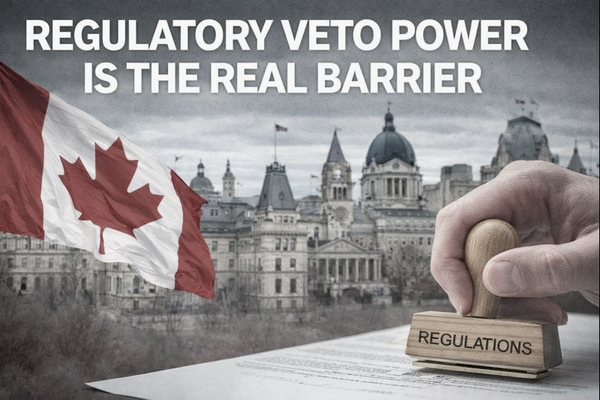
Capping Physical Speech: Why Bill C-9 Stops at the Gate
Isolating the access offences in Bill C-9: why criminal liability now turns on where conduct occurs. This Record stress-tests how proximity, not harm, becomes the governing legal threshold.

THE FACTS
Bill C-9 amends the Criminal Code to create new offences related to intimidation or obstruction tied to access to protected places under the bill text. The legislation specifies places of worship, educational institutions, and community centres as protected locations.
The access offences are triggered by conduct intended to impede entry or intimidate persons seeking access near those locations, regardless of whether physical violence occurs.
The bill also amends the hate propaganda framework by removing the Attorney General consent requirement for certain prosecutions (consent provision). The new access offences remain subject to ordinary police investigation and charge-laying discretion under existing Criminal Code procedures.
The offence language does not prescribe distance thresholds, time limits, or protest exemptions, leaving proximity and intent to be assessed contextually.
Statistics Canada reported 4,882 police-reported hate crimes nationally in 2024. The agency uses the same police-reported framework for 2023, enabling year-over-year comparison. Bill C-9 does not establish a distinct reporting category for access-related offences within Statistics Canada’s crime tables.
CRIME REPORTING IN CANADA
| Measurement / Classification | Before Bill C-9 | After Bill C-9 |
|---|---|---|
| New Criminal Code access offence exists | No | Yes |
| Statistics Canada creates a distinct “access offence” category | No | No |
| Police discretion determines charging under the offence | Contextual | Contextual |
| Location is a primary liability trigger near protected places | No | Yes |
| Hate-crime trend comparable | Yes | Partially |
THE SPIN
Sources: CBC News, Toronto Star, National Post
The Left: Safeguarding vulnerable institutions
Access is not theoretical when targeted groups are pressured at the door. Worship, education, and community services become conditional when intimidation occupies the entry point. Protest rights do not include a protected space for coercion where people must pass to participate in public life.
Bill C-9 treats entrances as a governance boundary where the state intervenes earlier than assault or property damage. If that boundary constrains aggressive tactics, the frame treats it as a required trade-off for equal access.
The Right: Criminalizing the sidewalk
This is how freedoms narrow in practice: through vague location offences where intent is read from proximity. Bill C-9 turns ordinary presence into a legal risk because “obstruction” is defined by context, not a measurable boundary. Protest and counter-speech often occur at the exact institutions being challenged, which makes “access” a contested concept rather than a neutral threshold.
A taxpayer-funded enforcement tool with elastic criteria invites selective use under political pressure. Once place becomes the trigger, oversight becomes the only guardrail.
THE WORLD VIEW
The United States of America
Sources: New York Times, Washington Post, Fox News
U.S. coverage tends to frame Bill C-9 as a divergence in how North American democracies manage assembly near sensitive sites. Analysts often foreground constitutional analogies, treating Canadian criminal-law design as a test case for location-based speech limits.
Democratic-aligned commentary generally frames the objective as protecting civic spaces from intimidation tied to polarized conflict. Republican-aligned commentary generally frames the objective as a discretionary tool that can be applied unevenly against dissent.
The Global View
Sources: The Guardian, Al Jazeera, Deutsche Welle
International coverage often frames Bill C-9 through rising communal tension and the securitization of public space in liberal democracies. Reporting frequently links Canadian policy design to spillover pressures from global conflicts that localize through protests at symbolic institutions.
Canada is often presented as a case study in how states separate “access” from “expression” to preserve public order. Some outlets treat the approach as a template other jurisdictions could adopt near religious or cultural sites.
WHAT THIS MEANS
Will my weekend protest get me arrested?
Possibly.
The offence requires proof that the conduct was intended to intimidate or obstruct access. If there is no measurable buffer in the law, location becomes the main evidence around which intent is argued. That increases the role of police judgment at the scene. It also increases legal uncertainty for people trying to stay compliant.
Does this make entrances to schools and worship places safer?
Yes, at the doorway.
The law is built to intervene at the point of entry rather than after escalation. It gives police a clearer Criminal Code hook to clear intimidation or blockage without waiting for violence. It does not resolve the underlying dispute that produced the gathering. It can displace the confrontation to nearby streets.
Will this reduce hate crimes overall?
Not in the near term.
The access offences govern conduct tied to place, not motivation across the full hate-crime spectrum. Removing Attorney General consent can change prosecution pathways for hate propaganda, which affects a different part of the enforcement pipeline. The hate-crime count is driven by reporting, investigation capacity, and charge selection. Those drivers do not automatically change because an access offence exists.
Will enforcement look the same in every province?
No.
The Criminal Code is federal, but police services triage calls under local operational priorities. Without a statutory distance marker, local practice can evolve into informal “working zones” that differ by city. Crown charging practices and judicial interpretation can also diverge regionally. The result can be uneven predictability even under the same text.
Does this affect how Canada is discussed abroad?
Yes.
Foreign coverage often reads this as a public-order tool that manages conflict spatially rather than through content regulation. That framing positions Canada as willing to use criminal law to protect specific institutions from intimidation at the access point. It can be used as precedent in debates in other democracies facing similar protest dynamics. It also changes how Canadian rights trade-offs are summarized in comparative coverage.
THE SILENT STORY
ACCESS THE TRIGGER
Public debate centres on hate versus speech. The governing force is neither. It is access enforcement that converts geography into criminal exposure. Bill C-9 does not require a determination about expression. It requires a determination about place.
Under the access offences, criminal liability is activated by a spatial switch. The same conduct can remain lawful on one side of an entrance and become chargeable on the other. That switch is binary and immediate. It is not moderated by volume, duration, or escalation. Location is assessed first; motive follows later.
This reverses the standard sequencing of criminal law. Ordinarily, intent justifies investigation into an act. Under Bill C-9, proximity justifies detention, and intent is reconstructed afterward through officer testimony. Geography supplies the actus reus. Mens rea is inferred after the fact.
The statute provides no measurable anchor for that judgment. There is no distance, no buffer, and no temporal threshold defining when presence becomes obstruction or intimidation. Officers must decide whether someone is “near” a protected place before determining whether conduct crosses a criminal line. That decision is necessarily situational.
The scale of that discretion is structural. Canada has more than 30,000 schools and places of worship. Each becomes a high-discretion zone under the access framework. Across major municipalities, this fragments the public square into a checkerboard of localized liability thresholds that shift by entrance design, crowd flow, and event context.
Prosecutors inherit this ambiguity. They must advance cases without objective measurements, relying on narrative context to establish fear, obstruction, or intimidation. Courts must then adjudicate credibility rather than verify instruments. These cases cannot be resolved mechanically. Each proceeds through cross-examination of perception.
This is where money stops mattering. Additional funding can increase police presence, but it cannot supply a tool that measures intimidation. Every contested charge is a guaranteed hearing. The downstream effect is not faster enforcement but accumulated load on provincial courts, where resolution depends entirely on subjective testimony.
The incentive structure explains the design’s persistence. Political payoff comes from visible protection of doors and gates. Media payoff comes from confrontations compressed into camera-friendly thresholds. What disappears is cognitive clarity for the public. Access control does not eliminate conflict; it redistributes it into adjacent space where certainty dissolves.
“Where you stand decides how the law classifies you.”
If this governing force remains, enforcement will continue to read firm in statute and behave variable in practice. The risk is not universal repression. It is uneven predictability. Legal boundaries will exist physically but not cognitively, leaving citizens to discover them only after crossing them.
SOURCE LEDGER
- Parliament of Canada — Bill C-9: An Act to amend the Criminal Code (hate propaganda, hate crime and access to religious or cultural places)
- Parliament of Canada — C-9 (45-1) — LEGISinfo
- Department of Justice Canada — Government of Canada introduces legislation to combat hate crimes, intimidation and obstruction at religious and cultural places (2025)
- Statistics Canada — Police-reported crime statistics in Canada, 2024 (The Daily)
- Statistics Canada — High income tax filers in Canada (Table 11-10-0055-01)