C-70: FOREIGN INTERFERENCE ENFORCEMENT REGISTRY PHASE-IN
Auditing the C-70 foreign-influence registry: why intent-based enforcement collides with open research systems. This Record isolates the enforcement ceiling and stress-tests the compliance burden facing universities and trade-exposed sectors.


The Foreign Influence Transparency Registry is created by Bill C-70, which amends the Security of Information Act to require registration of certain activities conducted under foreign state direction. Administration of the registry is statutorily assigned to the Minister of Public Safety. The Act establishes criminal offences for non-registration where foreign direction or control is present.
Federal fiscal planning identifies approximately $140 million annually for registry administration, investigative capacity, and compliance oversight. Operational enforcement is linked to the RCMP, with intelligence coordination involving the Canadian Security Intelligence Service. Staffing growth is constrained by security clearance requirements and specialized national security training mandated for designated investigators.
Canadian universities and federally funded researchers operate under Tri-Agency funding rules that require disclosure of international partnerships and risk mitigation measures. These frameworks do not prohibit foreign collaboration but impose governance and reporting conditions. The registry’s scope extends to individuals and entities engaged in foreign-directed influence activities, including research and advisory roles, creating overlap between national security enforcement and academic disclosure regimes.
TAXPAYER COST
| Income Category | Share of Tax | Cost Per Person |
|---|---|---|
| Top 10% | 54% | $24.23 |
| Middle 40% | 41% | $9.19 |
| Bottom 50% | 5% | $2.24 |
THE SPIN
Sources: CBC News, Globe and Mail, National Post
THE LEFT: TRANSPARENCY AS DEMOCRATIC DEFENCE
From this frame, the registry is not an administrative tool but a line of democratic self-defence long overdue. Foreign interference is described as a systemic, coordinated pressure campaign that thrives in opacity and disproportionately harms marginalized communities, diaspora voices, and public institutions already weakened by decades of neglect.
Universities and research hubs are not innocent abstractions but contested terrain inside global power struggles. Paperwork and disclosure are framed as the minimum civic burden of operating in a shared democracy. Objections are cast as elite discomfort with losing unaccountable access, dressed up as concern for efficiency or academic freedom.
THE RIGHT: SECURITY EXPANSION WITHOUT CONTROL
In this telling, the registry is another top-down security expansion sold on fear and implemented through bureaucracy. Ottawa is portrayed as outsourcing political accountability to compliance checklists while downloading cost and legal risk onto researchers, businesses, and institutions least equipped to absorb it.
Universities become collateral damage in a blunt regulatory sweep that treats collaboration as suspicion by default. Enforcement ambiguity is not a side effect but the core problem: rules written broadly, powers defined loosely, and taxpayers left holding the bill. Skepticism is framed as basic governance hygiene, not denial of foreign threats.
THE WORLD VIEW
The United States of America
Sources: New York Times, Foreign Policy
U.S. coverage frames the registry primarily as alliance alignment rather than domestic reform. Democratic-leaning outlets interpret it as Canada closing a known vulnerability and harmonizing with Australian and British counter-interference regimes. Republican-aligned commentary focuses on regulatory spillover, warning that compliance drag could erode research competitiveness and private-sector collaboration.
Canada is positioned as a willing but cautious partner, testing how far security frameworks can expand without constraining innovation capacity.
The Global View
Sources: Financial Times, Nikkei Asia
International coverage situates the registry within strategic competition with China rather than Canadian internal politics. The policy is framed as a signaling instrument to allies and investors about Canada’s security posture. Coverage emphasizes trade friction, academic mobility, and regulatory alignment as downstream variables.
Canada is portrayed as navigating openness constraints under rising geopolitical pressure, with long-term implications for research networks and cross-border capital flows.
WHAT THIS MEANS
Will this raise my taxes or fees?
Not in the short term.
The program is funded through existing federal spending rather than a new levy. Costs are absorbed across the general tax base. Any fiscal pressure shows up indirectly through constrained room for other spending priorities, not a line item on household bills.
Will this make it harder for Canadians to work or study internationally?
Yes, for some fields.
Researchers and professionals in sensitive or policy-adjacent areas face longer disclosure and review timelines. International collaborations may require additional approvals before funding or participation. The impact is uneven and concentrated in security-relevant disciplines.
Will this change how universities and colleges operate day to day?
Yes.
Institutions are expanding compliance offices and internal review processes. Administrative workload increases for faculty and research staff. Collaboration decisions increasingly factor regulatory exposure alongside academic value.
Will certain parts of Canada feel this more than others?
Yes.
Provinces with large research universities and export-oriented sectors face higher compliance volume. Smaller institutions experience proportionally larger administrative strain. Regions with deep Asia-Pacific trade and academic ties encounter more frequent disclosure triggers.
Does this strengthen or weaken Canada internationally?
This reflects a trade-off.
Security credibility with allies improves. Academic and commercial flexibility narrows. Diplomatic and trade friction becomes more visible as enforcement expands.
THE SILENT STORY
ENFORCEMENT RUNS ON CLEARANCES AND CLOCKS
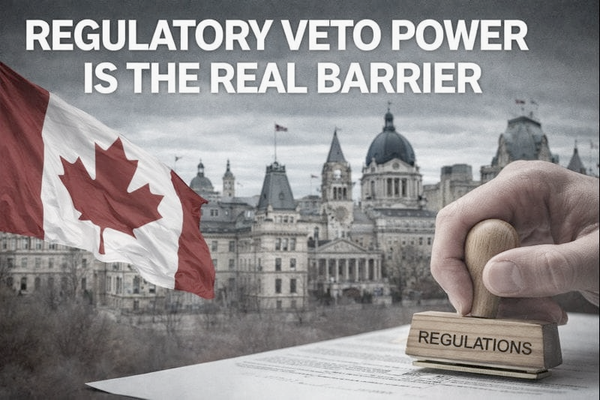
Public debate centers on foreign threats, deterrence, and transparency. What governs outcomes is not intent or funding but investigative throughput. The system being governed is the finite machinery of federal enforcement itself.
Investigations do not scale horizontally. Security clearances move one person at a time. Statutory authorities are role-specific. Legal training follows appointment and cannot precede it. Case review, evidentiary thresholds, and approval chains are sequential by design.
Money changes who applies, not how fast the gate opens. Clearance backlogs persist regardless of budget increases. Universities, firms, and researchers adapt immediately to new rules, while enforcement capacity expands on fixed timelines measured in years, not quarters.
The result is temporal inversion. Compliance obligations activate before investigative capacity exists to absorb them. Disclosure volume rises faster than verification capability. Enforcement credibility becomes dependent on selective focus rather than comprehensive reach.
Political and media incentives obscure this gap. Budget cycles reward visible program launches. Registries produce immediate artifacts. Staffing pipelines remain invisible until strain surfaces through delay, inconsistency, or quiet non-enforcement.
"You can change the rules overnight. Institutions change slowly."
If this constraint persists, enforcement lags expectation by design. Administrative friction accumulates ahead of deterrence. The system projects strength on paper while operating under hard throughput limits in practice.
SOURCE LEDGER
- Parliament of Canada — Bill C-70, An Act to amend the Criminal Code and the Security of Information Act (2024)
- Justice Canada — Security of Information Act (R.S.C., 1985, c. O-5)
- Treasury Board of Canada Secretariat — Main Estimates (2024–25)
- Canadian Security Intelligence Service — CSIS Annual Report (2023–24)
- Privy Council Office — Public Report on Foreign Interference in Canada’s Democratic Institutions (2024)