$6B Clean Power Credit Constrained by Grid Build Capacity
Mapping the $6B Clean Electricity Investment Tax Credit and its interaction with provincial grid timelines. This Record quantifies household tax exposure and isolates permitting, interconnection, and workforce constraints shaping electricity deployment.

THE FACTS
The Clean Electricity Investment Tax Credit (CE ITC) was introduced in Budget 2023 as a refundable credit covering 15 percent of eligible capital costs for non-emitting electricity generation, storage, and transmission. The credit applies to projects owned by taxable corporations, Crown corporations, municipalities, and Indigenous entities. Eligibility requires net-zero electricity generation by 2035. Legislative authority is provided through amendments to the Income Tax Act.
Budget 2023 estimated the fiscal cost of the CE ITC at approximately $6.3 billion over four years starting in 2024–25. Budget 2024 reaffirmed the program design and timing, with updated cost projections remaining within the same order of magnitude. Costs are recorded as tax expenditures and do not flow through annual departmental appropriations. Uptake depends on project completion dates and certification.
The credit is contingent on prevailing wage and apprenticeship requirements, with reduced rates applied if conditions are not met. Claims require verification of eligible assets and in-service dates. Federal estimates note that provincial permitting, transmission interconnection, and skilled labour availability affect when credits can be claimed. Source documentation appears in federal budget plans and tax expenditure reports.
TAXPAYER COST
| Income Category | Share of Tax | Cost Per Person |
|---|---|---|
| Top 10% | 54% | $1,038 |
| Middle 40% | 41% | $197 |
| Bottom 50% | 5% | $19 |
THE SPIN
Sources: Toronto Star, National Observer, Financial Post, Globe and Mail
The Left: Power as Public Infrastructure
The credit is framed as overdue public investment correcting decades of underbuilding and privatized grid inertia. Clean electricity is treated as a public health and equity requirement, with communities and workers positioned as beneficiaries of inclusion and access. Delays are attributed to historical underinvestment and fragmented markets, not program design. Cost is secondary to prevention, climate stability, and systemic transition. Resistance is framed as political inertia protecting incumbent energy interests while marginalized regions face higher risks from grid failure and climate impacts.
The Right: Subsidizing Promises Without Control
This is framed as Ottawa writing open-ended cheques for political promises it cannot deliver. The credit shifts financial risk onto taxpayers while provinces control permits, labour, and grid construction, leaving no accountable owner for results. Clean power rhetoric substitutes for timelines, capacity, and reliability guarantees. Cost estimates are treated as optimistic placeholders, not enforceable limits. Skepticism is framed as realism: subsidizing capital spending without control over execution produces higher costs, slower delivery, and fewer megawatts than advertised.
THE WORLD VIEW
The United States of America
Sources: Wall Street Journal, Washington Post, Politico
U.S. coverage frames Canada’s credit through the lens of North American supply chains and grid integration. The policy is interpreted as alignment with Inflation Reduction Act incentives, reducing cross-border distortion. Democratic-aligned outlets emphasize coordination and decarbonization scale, while Republican-aligned commentary highlights subsidy competition and fiscal exposure. Canada is framed as a complementary but capacity-constrained partner. Grid interconnection and permitting delays are emphasized as limiting leverage.
The Global View
Sources: Financial Times, Economist, Reuters Breakingviews
Global outlets frame the credit as part of advanced economy subsidy competition in clean power. Canada is positioned as fiscally willing but structurally slow compared to peers. Coverage emphasizes grid capacity, permitting, and labour as binding constraints. Long-term implications are framed around industrial competitiveness and capital mobility. The credit is treated as signal-setting rather than outcome-determining.
WHAT THIS MEANS
Will this lower my electricity bill soon?
No, not in the near term.
Credits apply after construction and grid connection. Most projects face multi-year timelines. Retail rates depend on provincial regulation and existing contracts.
Does this help younger Canadians more than older ones?
Possibly, but not directly.
Benefits accrue through long-term grid capacity. Costs are immediate through foregone revenue. Timing favors future users over current taxpayers.
Will utilities and developers build faster because of this?
Not necessarily.
Tax credits improve project economics. Permits, labour, and transmission access govern schedules. These factors are not controlled by the credit.
Does this affect provinces differently?
Yes.
Provinces with faster permitting and transmission access can claim sooner. Others face delays regardless of federal incentives. Regional build capacity diverges.
Does this strengthen Canada’s position internationally?
It's a trade-off.
The credit signals alignment with allies. Delivery speed determines credibility. Capacity limits shape outcomes more than stated ambition.
THE SILENT STORY
PERMITS, LABOUR, AND TRANSMISSION SET THE CLOCK
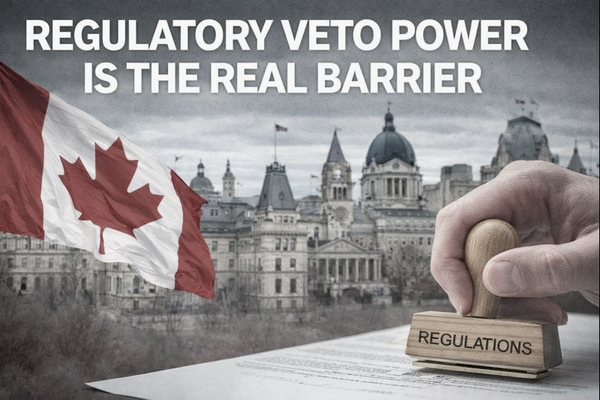
Public debate focuses on the size of the credit and climate targets. The limiting factor is physical grid expansion. The constraint sits inside provincial permitting, workforce training, and transmission interconnection systems.
Grid expansion requires sequential approvals, land access, engineering, and specialized construction crews. Training for linemen, engineers, and system operators follows fixed certification timelines. Interconnection studies and reliability assessments cannot be compressed without system risk. Money accelerates financing decisions, not physical sequencing.
These constraints persist because budget cycles reward announcements, not completion. Tax expenditures appear faster than infrastructure delivery. Media coverage tracks dollars committed, not years consumed.
“You can fund a transformer today, but you cannot skip the years it takes to install it.”
If the constraint persists, fiscal exposure will materialize before capacity. Apparent progress will outpace delivered electricity. The gap between announced transition and operational grid will widen.
SOURCE LEDGER
- Department of Finance Canada — Budget 2023: A Made-in-Canada Plan
- Department of Finance Canada — Budget 2024
- Canada Revenue Agency — Clean Electricity Investment Tax Credit Guidance
- Canada Energy Regulator — Canada’s Energy Future
- Parliamentary Budget Officer — Tax Expenditures and Evaluations